Event Strategy
Why Limited Attendance Matters
A smaller academy allows for stronger interaction with faculty, better questions and deeper discussion.
3 min read
Aug 7, 2026

Look closely at any beautifully sculpted torso and you're really looking at anatomy. The convex swell that catches the light is the belly of a muscle. The shadow that reads as an athletic hollow is the space beside it. The delicacy of a well-defined ankle depends on a prominent Achilles tendon with very little fat on either side of it. Nothing about high-definition results is arbitrary — every highlight and every shadow maps to a structure underneath.
Which is why, in Dr. Hoyos's approach, the surgeon has to see the body the way an anatomist and an artist do at the same time.
Consider what defines the lower leg: the medial and lateral heads of the gastrocnemius and the soleus create smooth convex prominences up high that taper toward the ankle. To sculpt that region well, you have to know precisely where each muscle sits, how it inserts, and how much superficial fat can be safely refined around it to reveal the form without flattening it.
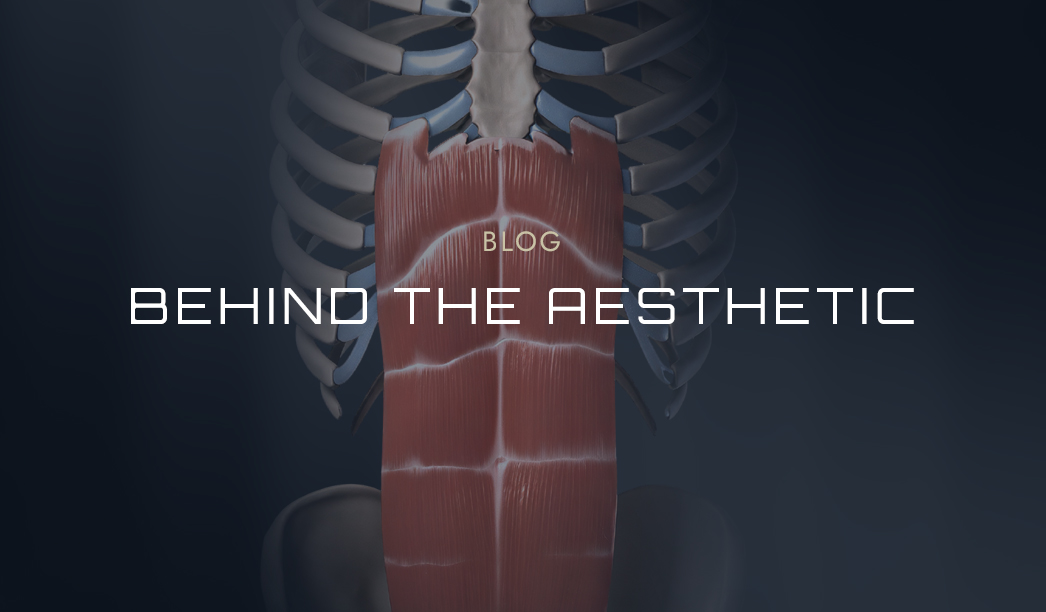
Multiply that by the whole body — the rectus abdominis and its uneven tendinous intersections, the serratus interdigitations along the flank, the frame of the pectoralis major, the erector spinae running as twin ridges along the back — and you begin to see why superficial anatomy is the true curriculum of body sculpting. The aesthetic is downstream of the anatomy.
Subcutaneous fat sits predominantly in the superficial fascia between skin and muscle, and it's distributed differently across regions and between patients. Reading those planes correctly — knowing what sits where, and how men and women differ — is fundamental to both safety and the final result. This is knowledge you can only fully internalize with a scalpel in hand and real anatomy in front of you.
You can memorize origins and insertions from an atlas. But developing the three-dimensional, tactile understanding that high-definition sculpting demands — the superposition of planes, the transition zones, the relationship between structure and surface — requires working through the layers yourself.
That's why the Beverly Hills Body Academy dedicates an entire day to an applied-anatomy cadaver lab, alongside live surgery with Dr. Alfredo Hoyos and Dr. Ashkan Ghavami. It's the difference between knowing the map and having walked the terrain.
Grounded in the published anatomical foundations of high-definition body sculpting. The hands-on application is taught only at the course.
Continue reading: How Concavity Creates Curvature